



Shine vs Wonder: Which Is Better for Beauty Brands?
Shine is built around the aspiration-led beauty buyer at $210. Wonder is a $390 multi-category conversion toolkit with a deep beauty preset. Here's how the two actually compare.
Short answer: for most single-brand beauty and skincare stores, Shine is the better pick. To be direct about something worth clearing up first: both themes ship shoppable images and shoppable video, and Wonder has offered that combination for longer than Shine has. So the case for Shine isn't "it has a mechanic Wonder doesn't." It's that Shine is built around one kind of buyer, the aspiration-led shopper who discovers a product through a styled photo or a look before they read a spec sheet, and beauty is where that buyer shows up most and where Shine currently leads with its full attention. At $210, that's 46% cheaper than Wonder's $390. Wonder's beauty demo is genuinely strong (it ships its own quiz tool, routine sections, and ingredient content), but that depth lives inside one preset of a five-preset theme whose broader roadmap is organized around a conversion toolkit applied across beauty, jewelry, food and drink, and fashion, rather than around one buyer type. Wonder is the better pick if you want that broader, more proven toolkit, or a catalog that isn't beauty-exclusive, or you have the budget for a premium $390 theme.
This isn't a case of one theme being objectively better than the other, and it isn't a case of one theme having a feature the other lacks. Shine was built around a buyer, the aspiration-led shopper, with beauty as the category getting its full design and engineering attention today. Wonder was built around a toolkit, conversion mechanics that work across beauty, jewelry, food and drink, and fashion, and its beauty preset happens to be a strong, dedicated execution of that toolkit within a broader system. That difference in organizing principle, buyer-first versus toolkit-first, not a mechanic gap, is the real decision here. Here's the full breakdown.
Comparison Table
| Theme | Price | Rating | Built for | Standout feature |
|---|---|---|---|---|
| Shine | $210 | 96% (25 reviews) | DTC / aspiration-led beauty & skincare buyers | Built around one buyer type, beauty is its leading, most fully-realized category |
| Wonder | $390 | 99% (145 reviews) | Multi-category conversion mechanics (beauty, jewelry, food & drink, fashion) | Deep beauty preset, but one of five presets across four categories |
Both data points were pulled live from each theme's Shopify Theme Store listing on September 10, 2026. Wonder's 99% rating across 145 reviews is real, and it's currently the stronger rating of the two, worth stating plainly rather than glossing over to make a case for Shine.
Shine at a Glance
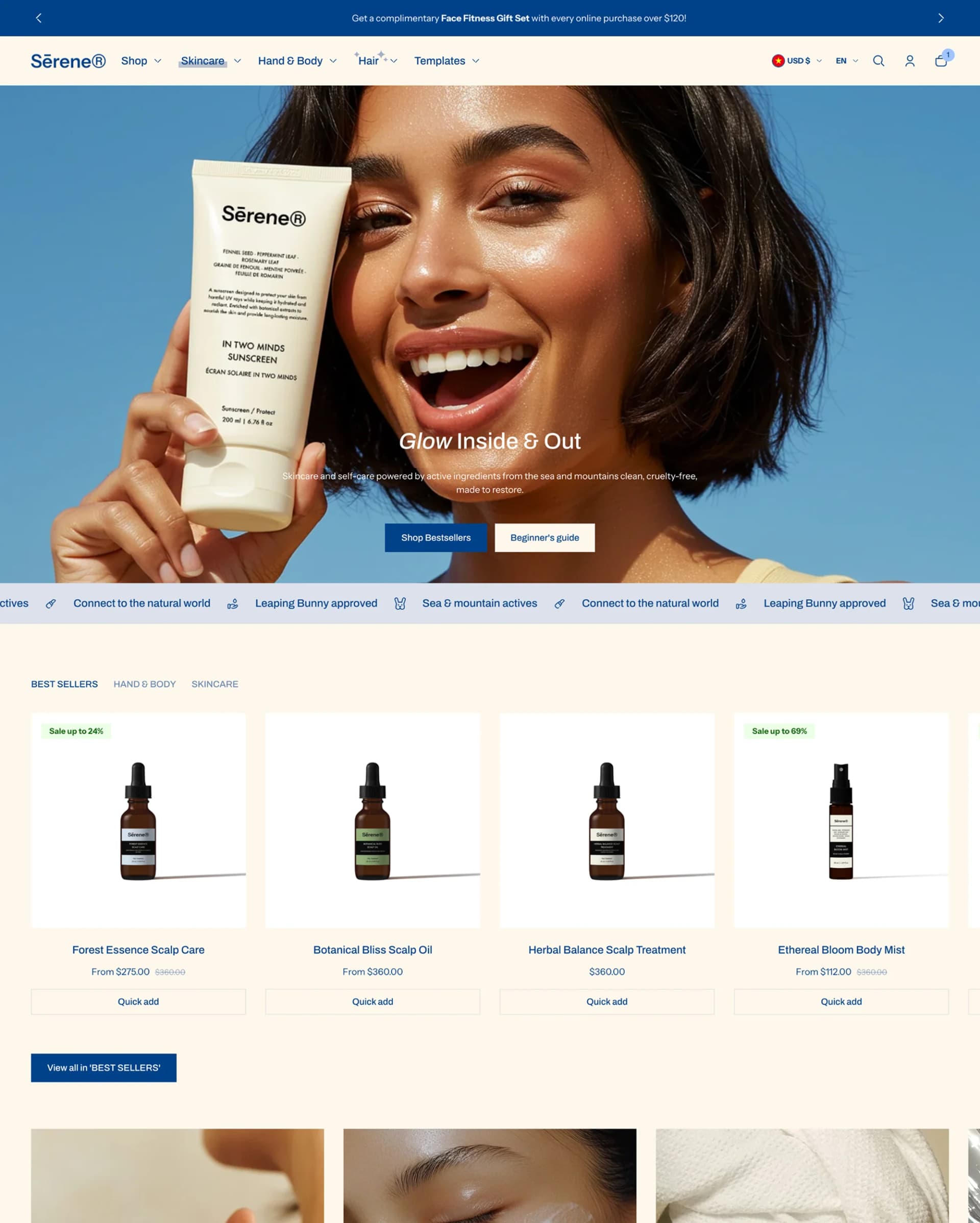
Shine costs $210 and runs on 500+ merchant stores, with a 96% positive rating across 25 reviews. It's eComX's theme for the aspiration-led shopper, built around a single buyer journey: aspiration, proof, ritual, purchase, and around using media to move that shopper through the journey faster than a standard product grid can. Beauty and skincare is where that buyer journey is most fully built out today, which is why Shine reads as a beauty specialist even though the underlying design principle is about a buyer type, not a category.
The feature worth leading with isn't a mechanic, it's focus. Shine lets you publish a styled photo, a full routine laid out on a counter, a finished look on a model, or a short product video, and make every product inside that media tappable and buyable directly, no separate product page required. A shopper doesn't need to click through to figure out what the serum in the shot is. They tap it, see the price, and add to cart from the same image or clip. Wonder ships shoppable images and video too, and has for longer than Shine, so this mechanic on its own isn't the reason to pick Shine. The reason is what sits around it: on Shine, that mechanic serves one buyer journey end to end, the ritual sequencing, the ingredient content, and the demo copy all assume the same aspiration-led shopper, expressed through beauty as the leading, most complete execution of that idea.
Shine also ships a real conversion toolkit alongside that discovery mechanic: countdown timers, trust badges, stock counters, product badges, cross-selling, promo banners and popups, and quick view, the same category of urgency and trust tooling Wonder leads with. Where Shine currently falls short of Wonder is breadth at the newer end of that toolkit: Wonder has since added bundles, quizzes, and subscription widgets that Shine doesn't ship yet.
Shine also ships before/after sliders and highlighted collections. Worth being straight about these: they're table stakes at this point, not differentiators. Most serious beauty themes ship both now, Wonder included. What separates Shine isn't any single feature, it's that the theme is organized around one buyer's journey, aspiration, then proof, then a ritual or routine, then purchase, rather than around a toolkit stretched across buyer types and categories.
For a single-brand beauty or skincare store, that focus shows up throughout the theme, not just in one headline feature, and it's the reason to compare Shine against Wonder's price and organizing logic rather than against a feature checklist the two themes now share.
Wonder at a Glance
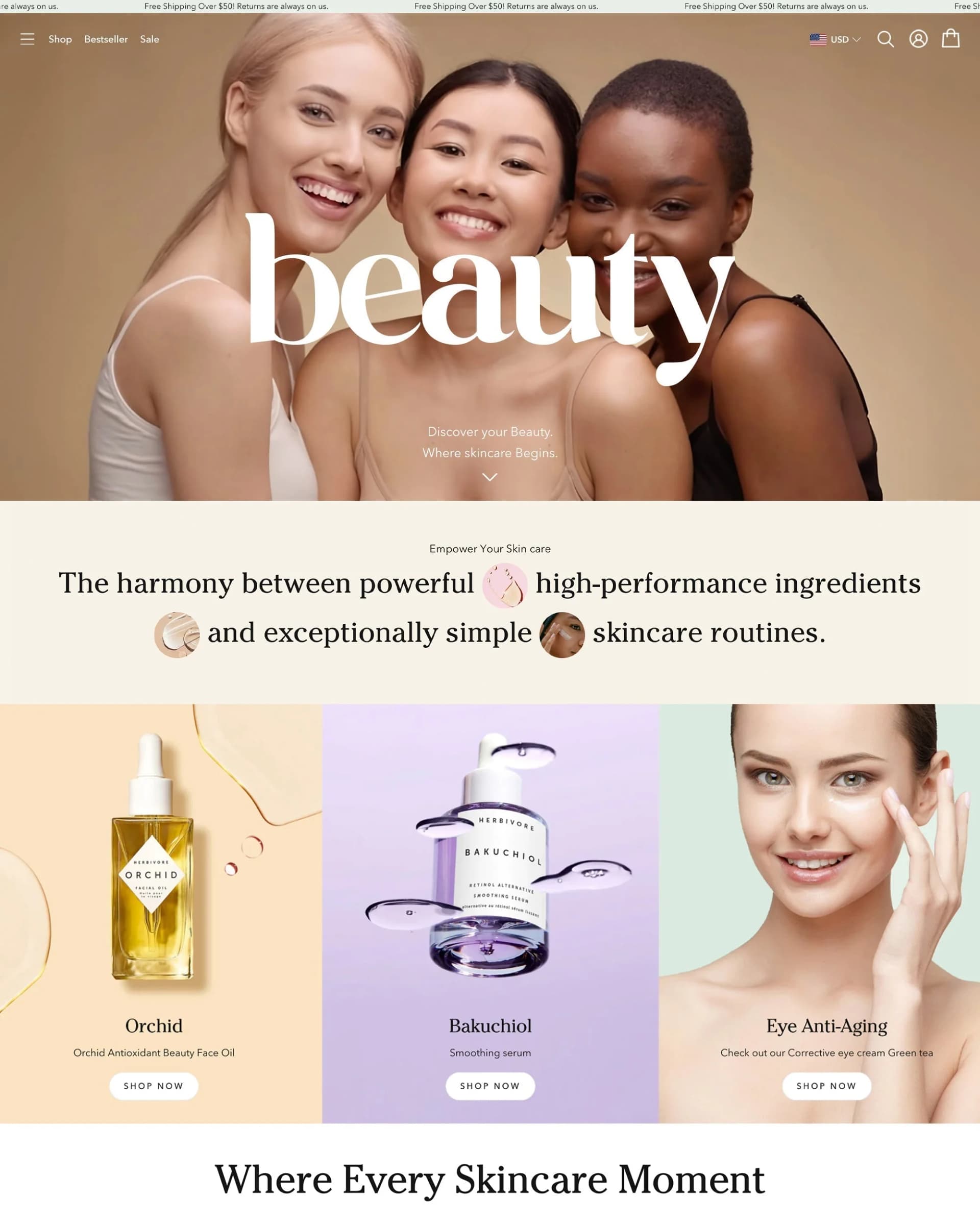
Wonder costs $390 and carries a 99% positive rating across 145 reviews, genuinely the stronger rating in this comparison, worth saying directly rather than downplaying it.
Wonder is built by NETHYPE on Baymard-informed research. It ships countdown timers for urgency, trust badges, image hotspots, product videos, and quick buy, and it has shipped shoppable images and video for longer than Shine has, worth crediting plainly rather than glossing over. Its current Theme Store listing also adds bundles, quizzes, and subscription widgets, plus what Wonder calls "AI-ready architecture," on top of that original toolkit. Its live beauty demo backs that up: it runs an interactive skin-type quiz, a routine section, ingredient-benefit content, and concern-based merchandising, a genuinely deep, beauty-native execution, not a generic layout with beauty photos dropped in.
What that demo is, though, is one of five presets inside a theme whose stated scope spans beauty, jewelry, food and drink, and fashion. That's a structural choice on Wonder's part, not a limitation. It's built to be the conversion layer under a wide range of store types, and the beauty preset is a well-built instance of that. But it means Wonder's roadmap is organized around the toolkit itself, what conversion mechanic gets built next, refined, or extended, applied wherever it's needed, rather than around one buyer's journey the way Shine's is. A quiz or subscription widget on Wonder works the same way regardless of what's being sold, even when, as in its beauty preset, it's dressed in beauty-specific copy and imagery.
On category standing, it's worth being accurate rather than either overstating or underselling it. Wonder has held a top-tier spot (non-New) in Shopify's own Beauty category throughout 2026, and its rating and review count have both grown over that period. Shopify's category ranking shifts over time as other themes move in and out, so an exact position is a snapshot, not a fixed fact. The durable point is that Wonder has consistently placed well ahead of where Shine sits in that same filter.
At $390, Wonder is priced as a premium, broadly-proven theme. For a store that needs urgency mechanics, trust signals, and quick-buy flows across more than one product category, that price buys a toolkit with a strong track record behind it.
Head-to-Head: The Real Trade-Off
Strip out price and rating for a second, and the real decision comes down to this: do you want a theme organized around one buyer's journey, currently most fully realized in beauty, or the broadest, most proven toolkit of conversion mechanics, one that happens to execute beauty well among other categories?
Buyer-first vs. toolkit-first. Both themes ship shoppable images and video, and Wonder's beauty preset backs it up with its own quiz, routine, and ingredient content. The real difference isn't the mechanic, it's what each theme is organized around: Shine is built around the aspiration-led shopper's journey, with beauty as its leading, most complete execution; Wonder is built around a conversion toolkit applied across beauty, jewelry, food and drink, and fashion.
Conversion breadth. Both themes ship a real conversion toolkit, countdown timers, trust badges, stock counters, cross-selling, promo popups, quick view, on both. Wonder's is currently the broader one, adding bundles, quizzes, and subscription widgets that Shine doesn't have yet. It's proven across multiple niches, and Wonder currently carries the stronger rating of the two themes: 99% versus 96%.
Price. Shine is $180 cheaper, a 46% lower price point than Wonder's $390.
Category standing. Wonder currently ranks ahead of Shine in Shopify's live Beauty category filter. Shine's presence there is limited to its Serene preset, which shows up on page three of that filter, around position 56 of 133 listed themes. That's a real but modest presence, not a ranking win, and it's more honest to say so than to omit it.
Neither theme is a bad choice, and neither wins on mechanics alone since the two now overlap heavily there. They're built on different organizing principles: a theme designed around one buyer's journey, with beauty as its current flagship expression of that, or a wider conversion toolkit with a longer track record and a deeper feature set, spanning more than one store type, that happens to execute beauty well too. The right call depends on which principle matches your actual catalog and content, not on which theme sounds more impressive on paper.
When Wonder Is Genuinely the Better Pick
Wonder is the right call if your store isn't beauty-exclusive. If you're running a catalog that spans beauty alongside jewelry, food and drink, or fashion items, Wonder's mechanics were built to work across all of them, not retrofitted from a single-niche theme. It's also the right call if you want Wonder's beauty preset specifically, its quiz tool, routine section, and ingredient content are a genuinely deep beauty execution, and simply value Wonder's stronger review base and rating, 99% across 145 reviews, over a theme built around a narrower buyer journey. Some merchants weigh a proven track record over that kind of dedicated focus, and that's a legitimate priority.
Budget matters here too. If $390 is comfortably within reach and what you actually want is urgency mechanics, trust badges, quick-buy flows, and now bundling and quiz-driven product discovery across your storefront, Wonder delivers a broadly-proven version of all of it. You're not paying a premium for beauty-specific features you won't use. You're paying for a toolkit of conversion mechanics that happens to include beauty among the categories it was designed for.
When Shine Is the Better Pick
Shine is the better pick for any single-brand beauty or skincare store where budget matters and your customer is the aspiration-led shopper Shine is built around. If you're shooting routine flat-lays, full-look product shots, quick demo clips, or social-first content, Shine's shoppable-media mechanic maps directly onto content you're probably already producing, the same way Wonder's does. The difference is that everything around that mechanic on Shine, the ritual structure, the ingredient content, the presets, is built for that one buyer journey end to end, with beauty as its most complete, most fully-realized expression today. That's not a small advantage. It means the theme's whole design logic, not just one section, is pointed at how that buyer actually shops.
Budget is the other half of the case. At $210, Shine is $180 cheaper than Wonder, and for a founder-led or early-stage beauty brand, that gap can matter as much as any single feature, especially since the live demos show Shine getting to a comparably beauty-native storefront, ritual sequencing, ingredient education, bundling, at a fraction of Wonder's price. This is the fit for most beauty brands evaluating this specific pair: single-niche, budget-conscious, and not yet needing Wonder's extra layer of quizzes and subscription mechanics or its longer track record.
Verdict: Decision Checklist
- Beauty-exclusive brand, budget-conscious, your customer shops off inspiration and styled media first → Shine.
- Catalog spans beauty and other niches, or you want the broadest conversion toolkit (bundles, quizzes, subscriptions included) and a longer track record, and budget supports a premium theme → Wonder.
- Not sure which bucket you're in? Both themes now ship shoppable images and video, so don't decide on that alone. Decide on organizing principle and budget: a theme built around your buyer's journey, currently led by beauty, at $210, or a proven multi-category toolkit theme at $390.
See Shine for Yourself
If your customer is the aspiration-led shopper, discovering product through a great photo or clip before they read a spec sheet, Shine's shoppable-image and video mechanic turns your existing photography and clips into a direct-buy surface, backed by its own countdown timers, trust badges, and cross-selling, without a separate build. eComX runs a free trial on every theme, so you can preview the mechanic on your own product photos before payment triggers on publish. Explore Shine on eComX to see it live.
Weighing Shine against a beauty-dedicated alternative instead of a multi-category conversion theme? Read our beauty-dedicated theme comparison for that breakdown.
More from the blog
Ready to convert more?
Stop leaving revenue on the table.
Your theme is the highest-leverage conversion tool you have.