



How Electronics Buyers Decide: Narrow, Compare, Confirm
Electronics buyers narrow a listing, compare specs side by side, then check reviews before they commit. Here's the research behind each step and what it means for your product pages.
Electronics buyers compare before they buy. Before a laptop or a pair of earbuds goes in the cart, they cut the listing down to a few options, line those up spec by spec, and check what other buyers said about the one they're leaning toward.
Nobody has a reliable number for how many tabs a buyer opens or how long they research. What does exist is research on each of those three steps, from studies where real buyers used real product pages. Here's what it shows, and what it means for the pages you're building.
Step 1: Narrowing the Field
Comparison starts on the listing page, and most listing pages aren't up to the job. Baymard Institute's 2024 study, updated in 2025, rated 58% of desktop ecommerce sites "poor" to "mediocre" on product-list UX. On mobile, it was 78% (Baymard Institute, 2024/2025).
Filters are a big part of that. A 2019 Baymard study found 38% of ecommerce sites don't let buyers filter by all the product information shown on the listing page (Baymard Institute, 2019). The data is older, but it's still the most direct figure on this question. Baymard's example is cameras: someone shopping for a camera wants to filter by megapixels, zoom range or lens mount. None of those mean anything for the TV listed next to it in the same catalog.
That's the problem specific to electronics. Price, color and brand filters don't match how these buyers narrow a list. They filter by the attributes that separate one product from another in that category.
What to do: check your listing pages against the specs your buyers actually compare, not the filters that were easiest to set up. If a buyer can't filter cameras by megapixels or laptops by RAM, they're doing work a competitor's site may not ask of them.
Step 2: Comparing Side by Side
With a shortlist in hand, buyers compare. Baymard runs a research program just for electronics and office retail. It benchmarks 17 major US and EU sites, including Amazon, B&H Photo, Newegg, Staples, Apple, Bose, Dell and HP, against 500+ UX guidelines. The work spans 25 rounds of usability testing with 4,400+ participant sessions, plus 12 quantitative studies covering 20,240 participants (Baymard Institute, ongoing).
The main finding is simple. When a spec-driven site offers a comparison feature, people use it. In Baymard's testing, 67% of participants used comparison features when they were available. Yet 17% of sites selling spec-driven products don't offer one (Baymard Institute, 2022).
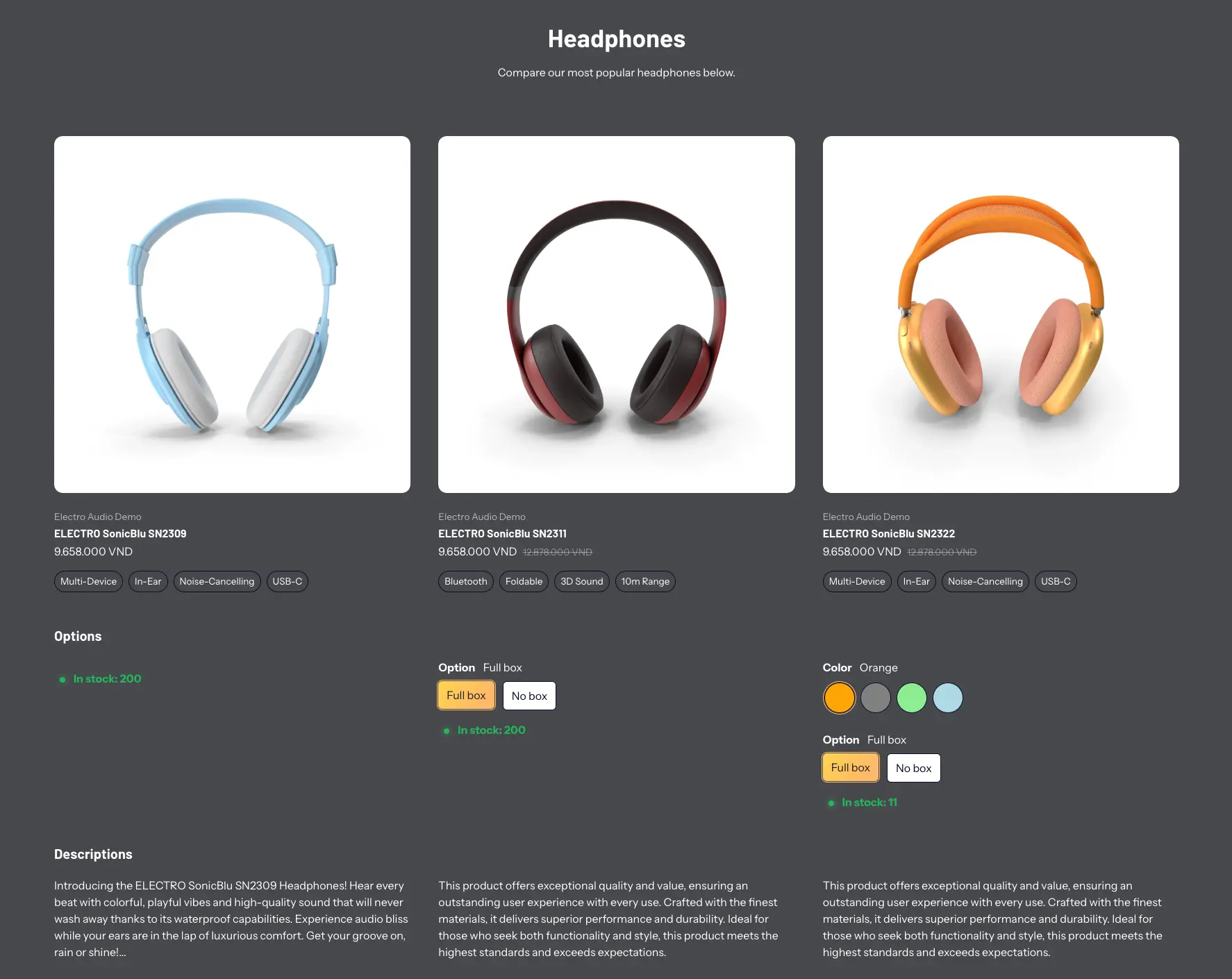
A comparison tool can still get in the way if it dumps every spec into one table. One Baymard participant put it this way: "It's a little bit overwhelming...it's a lot to scroll through. I'd really like it if they were able to not even show the information that is not different" (Baymard Institute, 2022). A 40-row table where 38 rows match doesn't speed up a decision. It adds scrolling.
What to do: if your catalog is spec-driven, treat comparison as part of the product page, not an add-on. And build it to show what's different first.
Step 3: Confirming With Reviews
After comparing specs, buyers look for proof. In electronics, that means reviews, more than in most other categories.
PowerReviews, which sells a ratings-and-reviews platform, surveyed 21,279 US consumers in 2025. Consumer electronics and appliances ranked first for how much review volume matters to the purchase, at 85%. Health and beauty came in at 81%, home improvement and furniture at 63%, and clothing at 62% (PowerReviews, 2025).
An earlier PowerReviews survey of 11,165 consumers found the same pattern. Electronics and appliances ranked first again, at 86%, for buyers who look for longer, detailed reviews before purchasing. Health and beauty was at 73% and clothing at 71% (PowerReviews, 2022). Two surveys, three years apart, same category on top.
The 2025 survey also found 85% of people are less likely to buy a product with no ratings or reviews at all (PowerReviews, 2025). On an electronics product page, the review section directly affects whether the sale happens.
Older site data points the same way. PowerReviews analyzed data from May 2020 to May 2021 and found electronics pages with 31-50 reviews converted 224.7% better than pages with none (PowerReviews, 2020-2021 data).
What a Weak Product Page Costs
When a product page is hard to compare or light on proof, the cost often arrives later as a return. The National Retail Federation projects consumers will return 19.3% of online purchases in 2025, worth $849.9 billion (NRF, 2025). That covers all online retail, not just electronics, but it shows what's at stake.
Salsify, which sells product-content software, surveyed buyers in 2025 and found 71% have returned something because it didn't match its online listing (Salsify, 2025). Keep in mind that Salsify sells a fix for this exact problem. The point holds either way: complete, accurate specs help buyers compare, and they also keep the box from coming back.
Product Page Checklist
- Let buyers filter by the specs they actually compare, not only price, color and brand.
- Give buyers a way to compare two or three products side by side without leaving your site.
- In any comparison view, show the differences first. Don't make people scroll past identical rows.
- Keep review counts visible and easy to find. Electronics buyers weigh review volume more than buyers in most categories.
- Encourage detailed reviews. Electronics buyers go looking for them.
- Avoid shipping product pages with zero reviews. Ask recent buyers to leave one.
- Keep specs complete and accurate on the listing. A mismatch there is a likely return.
Where Electro Fits
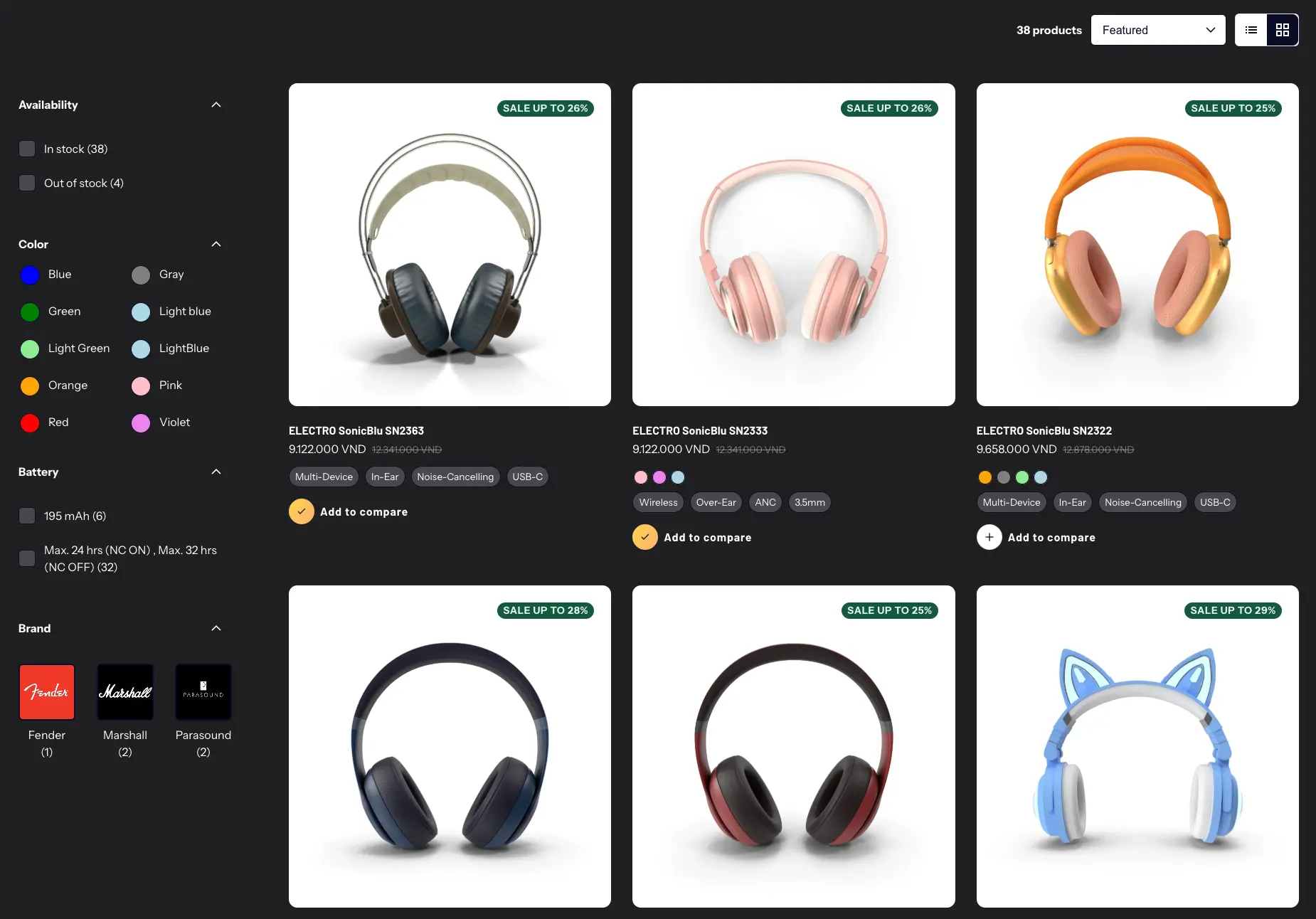
We built Electro around step two, comparison. It ships a native product comparison tool, so buyers can line products up on your site instead of opening a competitor's tab to check a spec sheet.
It also ships three filter types, including attribute filters built for the problem in Baymard's camera example. Buyers can filter by megapixels, RAM, wattage or whatever spec separates the products in your catalog.
Electro costs $300. As of September 23, 2026, it holds a 99% positive rating across 91 reviews on the Shopify Theme Store.
Any theme paired with a comparison app can cover this step too. The difference is that Electro has the spec-driven layout and comparison tool built in, so there's one less app to install, maintain and pay for.
Key Takeaways
- Electronics buyers go through three steps: narrow the listing, compare specs, confirm with reviews.
- Most listing pages fall short at step one. 58% of desktop sites and 78% of mobile sites rate poor to mediocre (Baymard, 2024/2025).
- Buyers use comparison tools when they exist. 67% did in testing, but 17% of spec-driven sites don't offer one (Baymard, 2022).
- Review volume and detail matter more for electronics than almost any other category, across two PowerReviews surveys three years apart.
- Accurate specs help buyers compare, and they also prevent returns.
FAQ
Do electronics stores need a comparison tool?
If your products are spec-driven, like laptops, cameras or appliances, the research says yes. Baymard's testing found 67% of participants used comparison features when offered, while 17% of spec-driven sites don't offer one (Baymard Institute, 2022).
What specs should I let buyers filter by?
The ones that separate products in your catalog. Baymard found 38% of sites don't offer filters for all the information they display. Its camera example (megapixels, zoom, lens mount) shows how category-specific those filters need to be (Baymard Institute, 2019).
How many reviews does an electronics product need?
There's no proven magic number. What we do know: 85% of people are less likely to buy a product with no reviews (PowerReviews, 2025). Get every product past zero first, then work toward longer, detailed reviews, which electronics buyers seek out more than buyers in most categories (PowerReviews, 2022).
Does a long comparison table help or hurt?
It depends on what it shows. In Baymard's testing, people got overwhelmed by tables that repeat identical specs row after row. You don't need fewer specs. You need to show the differences first (Baymard Institute, 2022).
See How Electro Handles It
If your buyers compare specs before they buy, Electro's comparison tool and attribute filters are built for that step. Explore Electro.
For a wider view, read our electronics theme roundup, or see how Electro compares with Warehouse and Impact.
More from the blog
Ready to convert more?
Stop leaving revenue on the table.
Your theme is the highest-leverage conversion tool you have.