

Shine vs Sense: Which Is Better for Beauty Brands?
Sense is one of Shopify's free default themes: a fine generic starting point, but not built for beauty at all. Shine is $210 and purpose-built for beauty and skincare from the ground up. Here's the honest breakdown.
Short answer: this isn't a fight between two beauty specialists. Sense is one of Shopify's free default themes. It's a fine generic starting point, but it isn't built for beauty at all. No beauty language in its own copy. No before/after mechanic. No shoppable imagery. And a 36% positive rating across 74 reviews, the weakest of any theme in this research thread. Shine is $210 and purpose-built for beauty and skincare from the ground up.
So the real question isn't "which is better" in the abstract. It's "does a beauty brand outgrow the free default." For most beauty and skincare stores, the answer is yes, and quickly.
Comparison Table
| Theme | Price | Rating | Built for | Standout feature |
|---|---|---|---|---|
| Shine | $210 | 96% (25 reviews) | DTC / single-brand beauty & skincare | Shoppable image looks |
| Sense | Free | 36% (74 reviews) | Shopify's general-purpose free default, no niche positioning | Extensive product detail layouts, not beauty-specific |
Both data points were pulled live from each theme's Shopify Theme Store listing on September 15, 2026. State the rating gap plainly: 96% versus 36%. That's the widest gap in any comparison eComX has published, not a minor spread worth rounding down.
What Sense Actually Is
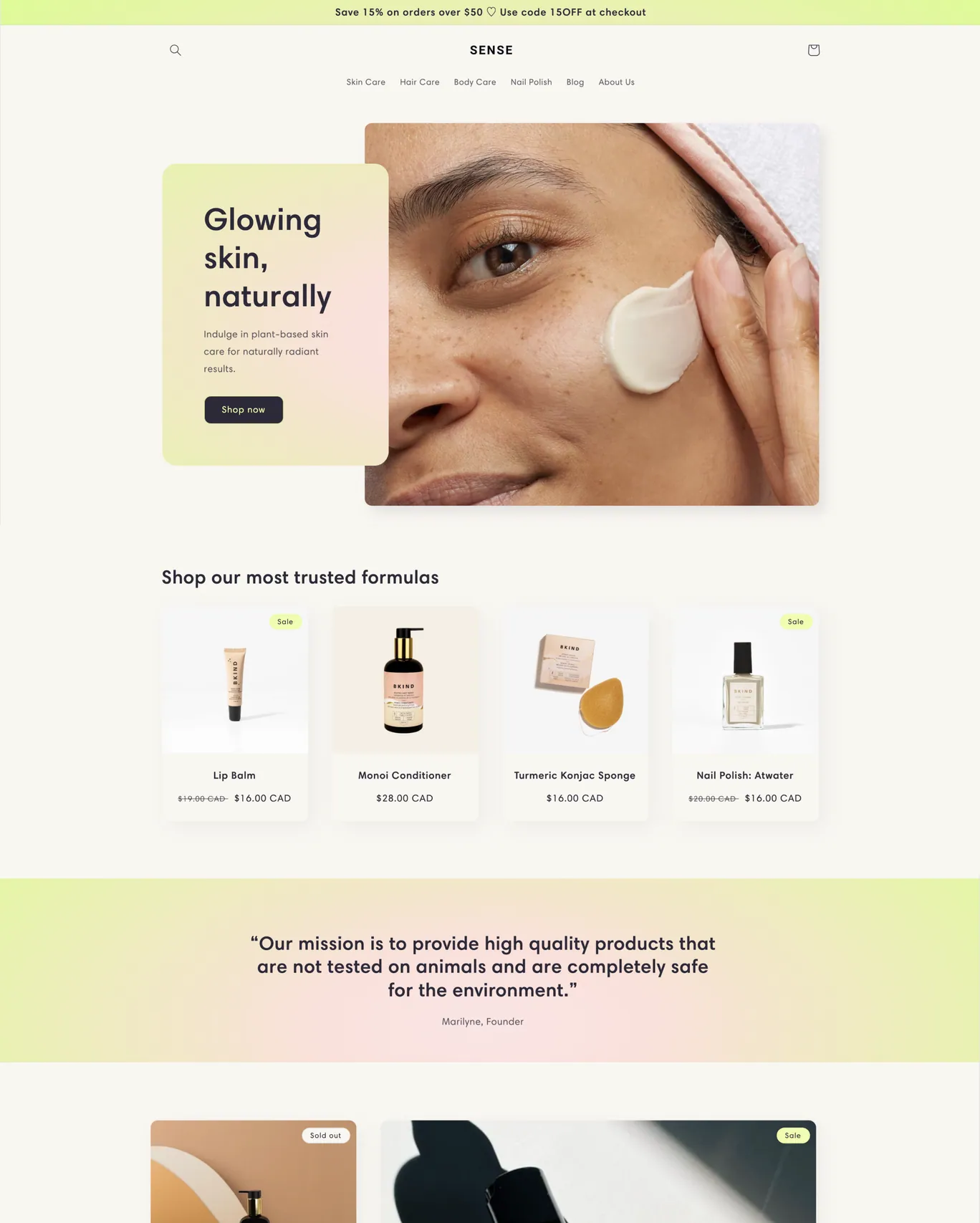
Sense is a real Shopify-built theme. The developer of record is Shopify itself, confirmed directly on its Theme Store listing. It's part of the free OS 2.0 default family, alongside Dawn, Horizon, Origin, Craft, Studio, Refresh, Spotlight, Taste, and more. Shopify now ships 20+ free themes across the Dawn and Horizon families, so treat any fixed count as a snapshot, not a permanent number.
Sense is a legitimate, no-cost way to launch a Shopify store fast. Its own tagline calls it "an energizing theme featuring extensive product detail layouts," and it ships a fresh color palette, testimonial and video blocks, and no-code customization. That's a real feature set. It's also a generic one, built for no store type in particular. Its own copy never mentions beauty, skincare, or wellness anywhere. It's the same theme a hardware store or a stationery brand might launch with.
Name the mechanism plainly: Sense's only functional tie to beauty is Shopify's own "More themes for beauty" related-content module, showing it as a suggestion. That's not a claim Sense makes about itself. It's a platform-generated recommendation, not a positioning choice by the theme.
Sense ranks near the bottom of Shopify's own live Beauty category filter, around position 116 of 135. It clusters there with other free defaults, Refresh and Pitch. That's well behind every paid beauty specialist tracked in this research, and behind Shine's own Serene preset, around position 53 of 135. Two independent signals point the same direction: the copy, and the category's own ranking. Sense's presence on a beauty merchant's shortlist is incidental, not earned.
Its rating tells the same story. Sense sits at 36% positive across 74 reviews, the weakest rating of any theme in this research thread. That number deserves to be stated plainly, not softened, any time reviews come up.
What Shine Adds
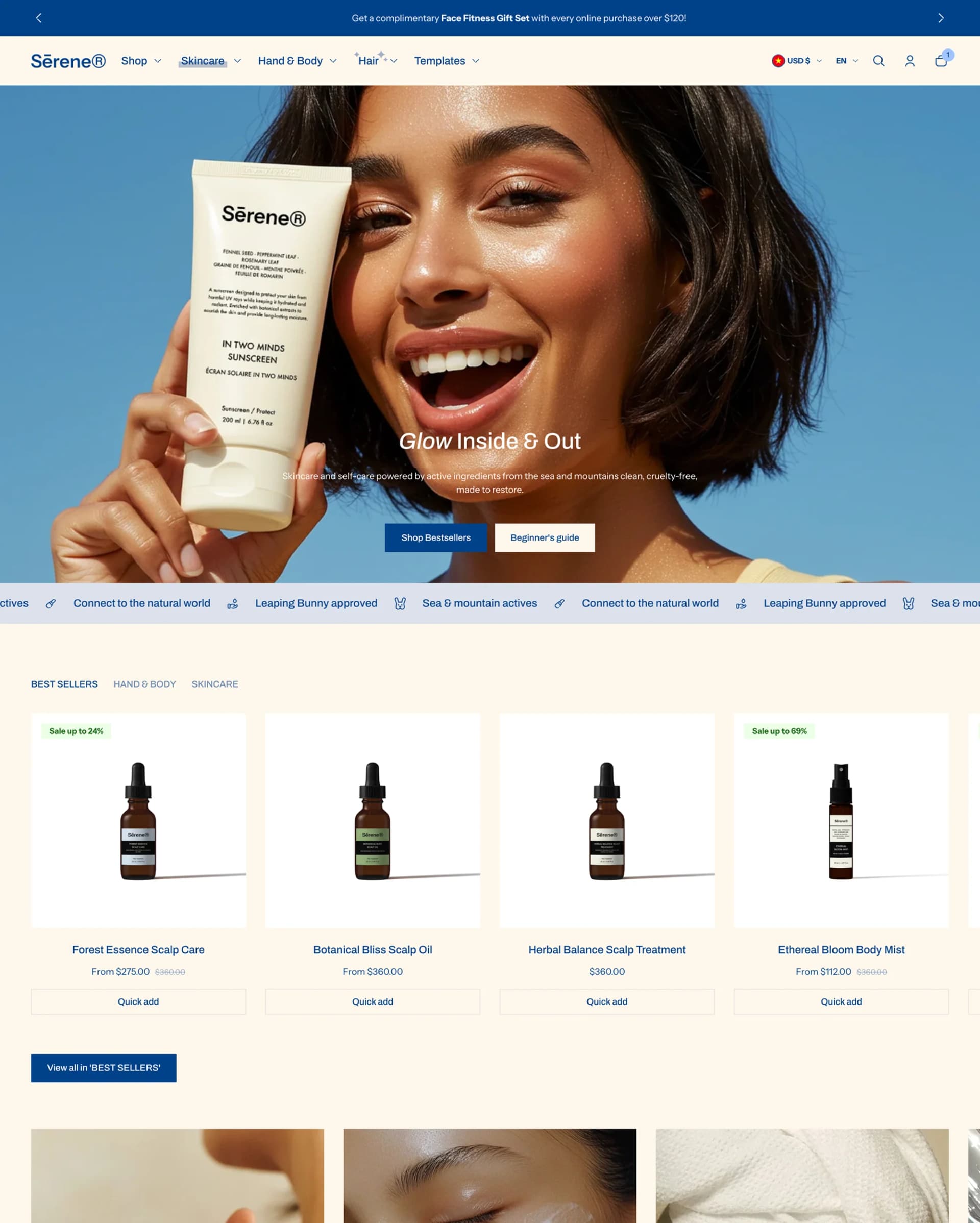
Shine costs $210. It carries a 96% positive rating across 25 reviews and runs on 500+ merchant stores. This is the section that carries the real "why upgrade" argument: what does a beauty brand have to build from scratch on Sense, that ships natively on Shine.
Start with shoppable image looks, Shine's standout mechanic. Take a styled photo, a routine flat-lay, a finished look on a model, and make every product inside that photo a tappable, direct-add-to-cart hotspot. A shopper doesn't click through to a separate product page to identify the serum in the shot. They tap it, see the price, and add to cart from the same image. Sense has no equivalent mechanic at all. A merchant who wants this on Sense needs a third-party app, and that app brings its own subscription cost, its own maintenance, and its own page-speed tradeoff.
Shine also ships before/after sliders, the mechanic a beauty or skincare brand uses to tell a transformation story. Sense has no native version of this either.
And Shine ships highlighted collections, beauty-appropriate merchandising built into the theme, not a generic product grid that reads the same whether the store sells serum or staplers.
Line these up against Sense and the real argument isn't feature count. It's total cost of ownership. Sense is free at checkout. Sense has no shoppable imagery, no transformation slider, no beauty-specific merchandising. A brand that wants those ends up paying anyway, just later: in app subscriptions, developer time, and slower page loads from stitching three separate tools onto a generic foundation. Shine is $210 once, with all three built in and tested for a beauty buyer's journey specifically, not bolted onto a theme that assumes nothing about what's being sold. Shine also ships a 95 desktop PageSpeed score, so none of that speed tradeoff shows up as a hidden cost on eComX's side of the comparison.
The Real Question: Free Starting Point or Purpose-Built Storefront?
Strip away the idea that this is a feature-for-feature fight. There's nothing to compare feature-for-feature. Sense has no beauty mechanics to put in the other column. The real decision comes down to four things.
Fit. Shine's entire structure assumes a beauty and skincare buyer journey: aspiration, proof, ritual, purchase. Sense assumes nothing about the niche. It's a blank, generic canvas that could sit under any kind of store.
Trust signal. 96% positive for Shine against 36% positive for Sense. That's the widest rating gap in any comparison eComX has published. Worth saying plainly rather than rounding it down to "a bit lower."
Cost, honestly. Sense is free. Shine is $210. Don't read that as "Shine is worth the extra cost," like it's a marginal upsell decision. Read it as: Sense's true cost shows up later, in the app subscriptions and developer time needed to bolt on what Shine already ships. Free now isn't the same as free over the life of the store.
Category standing. Sense sits near the bottom of Shopify's own live Beauty category filter, around position 116 of 135. Shine's Serene preset sits solidly mid-pack, around position 53 of 135. Category totals shift week to week, so treat both numbers as approximate. And it's fair to say both directions plainly: Shine's mid-pack standing is real, but it isn't a top-tier claim either.
Put those four together and the pattern holds. Sense is a legitimate free starting point with no opinion about what it's selling. Shine is a purpose-built storefront with an opinion baked into every section. Which one a beauty brand needs depends on what stage it's actually at.
When Sense Is Actually Fine
Sense is a reasonable pick for a beauty brand that's pre-launch, pre-revenue, or still testing a concept before committing to a niche theme. Free removes a real barrier at the earliest stage, when there's no budget to spare and no proof yet that the product will sell at all.
It's also a fine pick for a merchant who plans to build every beauty-specific mechanic themselves, through custom development or a stack of apps, and just wants an unopinionated foundation to start from. That's a legitimate approach for a technical founder or a team with in-house development resources.
This isn't the majority case this post is written for. Most beauty brands comparing Shine against Sense by name have already moved past the pure-testing stage. But naming the case where Sense makes sense keeps this comparison honest instead of one-sided.
When Shine Is the Better Pick
Shine is the better pick for any beauty or skincare brand past the pure-testing stage. That's a brand with real product photography, a routine or ritual story to tell, and a reason to invest $210 in a storefront that already assumes a beauty buyer instead of a generic one.
That covers most of the beauty brands actually evaluating this specific comparison. A brand asking "Shine vs Sense" by name has usually already worked out that a free theme with no niche opinion isn't the long-term answer. The question at that point isn't whether to upgrade, it's which purpose-built theme to upgrade to.
If the brand already has styled photography it's using on social, and wants that content to double as a direct shopping surface, Shine's shoppable-looks mechanic turns existing marketing assets into a sales channel without a separate build.
Verdict: Decision Checklist
- Pre-launch, testing a concept, zero budget for a theme → Sense, for now.
- Have real product photography, a routine or ritual story, and want beauty-specific mechanics without stitching apps together → Shine.
- Weighing the trust signal → Shine's 96% positive against Sense's 36% positive is the widest gap in this project's research. Don't discount it.
- Already building custom beauty mechanics in-house and just want a blank foundation → Sense can work, but budget for the developer time that gap implies.
See Shine for Yourself
If your beauty brand has outgrown a blank, generic foundation, Shine's shoppable-looks mechanic turns styled photography you're likely already shooting into a direct sales surface. eComX runs a free trial on every theme, so you can preview it on your own product photos before payment triggers on publish. Explore Shine on eComX to see it live.
More from the blog
Ready to convert more?
Stop leaving revenue on the table.
Your theme is the highest-leverage conversion tool you have.