


Smart Home & IoT Electronics: What Buyers Need to See Before They Trust a Purchase (2026)
Cost, privacy, security, setup, and compatibility stop smart home buyers in that order. Here's what each hesitation is, and the 8-item trust checklist your product page should carry to answer it.
A smart home shopper looking at your product page isn't only asking "is this good?" They're asking two harder questions: will it work in my house, and will it spy on me?
451 Research asked people who looked at smart home devices and didn't buy why they walked away. Cost topped the list, cited by 36% of non-buyers. Privacy came next at 21%, then security concerns at 19%. Complicated setup stopped 9%, and compatibility worries stopped another 4% (451 Research, Sept 2026).
Those five numbers are a smart home product page checklist, already ranked in order of what matters most. Skip any of them and you're leaving a specific, named group of buyers on the table. Here's what each hesitation is, and what to put on the page to answer it, without inventing a feature set that doesn't exist yet.
Hesitation 1: Cost and hidden subscriptions
Cost is the top reason people don't buy: 36% of non-buyers name it directly (451 Research, Sept 2026). But cost isn't only the sticker price. The same report found 19% of respondents "would never pay" a monthly smart home subscription, and another 19% are "somewhat unwilling," a combined 38% who resist recurring fees (451 Research, Sept 2026).
That's an objection your product page needs to answer before checkout, not after. A shopper who discovers a required subscription inside the setup app, after paying for the hardware, doesn't file a support ticket. They return the device.
What to put on the page:
- State the full cost of ownership up front: hardware price, and whether any core function requires a paid plan.
- Name what works without a subscription. If motion alerts are free but cloud video storage isn't, say so in the product description, not a footnote.
- If there is a plan, state its price next to the feature it unlocks.
This isn't an argument against subscriptions. Plenty of smart home products run one profitably. The trust issue is disclosure, not the fee itself.
Hesitation 2: Privacy and data
Parks Associates found 72% of smart home product owners are concerned about the security of the personal data their devices collect (Parks Associates, 2023). Those are owners, people who already bought in, still worried after the fact. For a shopper who hasn't purchased yet, that concern is a reason to close the tab.
Not every device category carries the same weight of concern. NIST surveyed 401 US smart home users across five device categories and found voice assistants rated the most concerning and least trusted, while thermostats and security devices rated the most trusted (NIST Special Publication 1343, Dec 2025). If you sell a voice-enabled product, expect to answer more privacy questions than a thermostat brand does, and build the page accordingly.
There's a real payoff for getting this right. Deloitte's 2025 Connected Consumer survey found the pattern across tech purchases generally: people who rate a tech provider as excelling on both innovation and data responsibility spend 62% more annually on tech devices than people who rate providers as lagging on both (Deloitte, 2025). It's not a smart-home-specific number, but the direction holds. Trust isn't just a hurdle to clear before purchase. It's tied to how much a customer is willing to spend afterward.
What to put on the page:
- A plain-language data summary: what's collected, and why.
- Whether processing happens locally or in the cloud.
- A direct link to the privacy policy from the product page itself, not just the site footer.
Hesitation 3: Security and support lifespan
Security concerns stop 19% of would-be buyers cold (451 Research, Sept 2026). Regulation is starting to turn that concern into a checklist.
The UK's product security regime under the PSTI Act has been in force since April 29, 2024 (UK government, 2024). It has three core requirements. Passwords must be unique per product or set by the user. Manufacturers must publish how to report security issues. And they must state the minimum period they'll provide security updates, with an end date. Those three items are a solid model for what a security-conscious product page should disclose, even for a merchant selling outside the UK.
The EU's Cyber Resilience Act is following a similar path on a slower timeline. It entered into force in December 2024. Vulnerability and incident reporting rules start September 11, 2026. The full set, including a mandatory security-update period, phases in by December 11, 2027 (European Commission). US regulation is further behind. The FCC's Cyber Trust Mark isn't live yet: the program is still selecting and accrediting administrators as of August 2026, and no product can currently carry the mark (Cybersecurity Dive, 2026). Don't put it on a page as though it's an available certification. It isn't yet.
Consumer Reports has been checking whether makers even have a disclosure channel: its 2025 Consumer Cyber Readiness report audited 75 smart home device makers on exactly that (Consumer Reports, 2025). Makers without a visible contact are being tracked publicly, whether or not their buyers ever see the report.
What to put on the page: a stated security-update period, and a visible way to report a vulnerability. None of this is legal advice. Check what actually applies to your product and market before you publish a compliance claim.
Hesitation 4: Compatibility and setup
Matter, the cross-platform smart home standard maintained by the Connectivity Standards Alliance, released version 1.6 in June 2026, along with a new tiered security certification called Product Security 1.1 (CSA, via Privacy Guides, June 2026). Matter 1.6 adds NFC-based setup. A device can be configured before it's even powered on, so no more hunting for a hidden QR code. No public adoption or certified-product counts are available yet, so don't cite an adoption percentage. State plainly whether your product is Matter-certified, and let that stand on its own.
The friction Matter is trying to solve is well documented, just with older data. TechSee, which sells remote-support software, found in a 2019 survey that 74% of respondents were somewhat likely, very likely, or certain to return a device they found difficult to use (TechSee, 2019). Parks Associates found in 2020 that 36% of returned devices were sent back specifically for setup, installation, or usage problems (Parks Associates, 2020), and in 2022 found that a third of people who gave up on setup did so within 30 minutes (Parks Associates, 2022). Treat these as directional rather than current, but the underlying pattern, that setup friction turns into returns fast, hasn't needed updating.
What to put on the page:
- A compatibility matrix: which ecosystems it works with (Alexa, Google Home, Apple Home), whether a hub is required, Wi-Fi band, and Matter/Thread support.
- A realistic setup time, stated in minutes, not "quick and easy."
- A short setup video, so a buyer can see the actual first-run flow before they own the box.
The trust checklist
Put those four hesitations together and here's what a smart home product page should carry, and why each item earns its place.
| Page element | Hesitation it answers | Source |
|---|---|---|
| Ecosystem list (Alexa, Google Home, Apple Home, Matter) stated before checkout | Compatibility (4% of non-buyers) and setup complexity (another 9%) | 451 Research, Sept 2026 |
| Subscription requirement and price, stated on the page itself | Cost, the top reason 36% of shoppers walk away | 451 Research, Sept 2026 |
| Plain-language data summary: what's collected, local vs. cloud | Privacy, the concern of 72% of owners | Parks Associates, 2023 |
| Minimum security-update duration, stated | Security, and a disclosure required under the UK's PSTI Act | UK government, 2024 |
| Visible vulnerability-disclosure contact | Same security concern; the exact gap Consumer Reports tracks across makers | Consumer Reports, 2025 |
| Realistic setup time and a setup video | Setup friction, tied to returns within the first 30 minutes | Parks Associates, 2022 |
| Matter/Thread certification stated plainly, no adoption-count claims | Compatibility and standards trust | CSA Matter 1.6, June 2026 |
| No unearned certification marks, such as the Cyber Trust Mark | Security credibility, without a claim that isn't live yet | Cybersecurity Dive, 2026 |
Eight items. None require new hardware or a new feature. They require the page to say, plainly, what's already true about the product.
Making it filterable and comparable
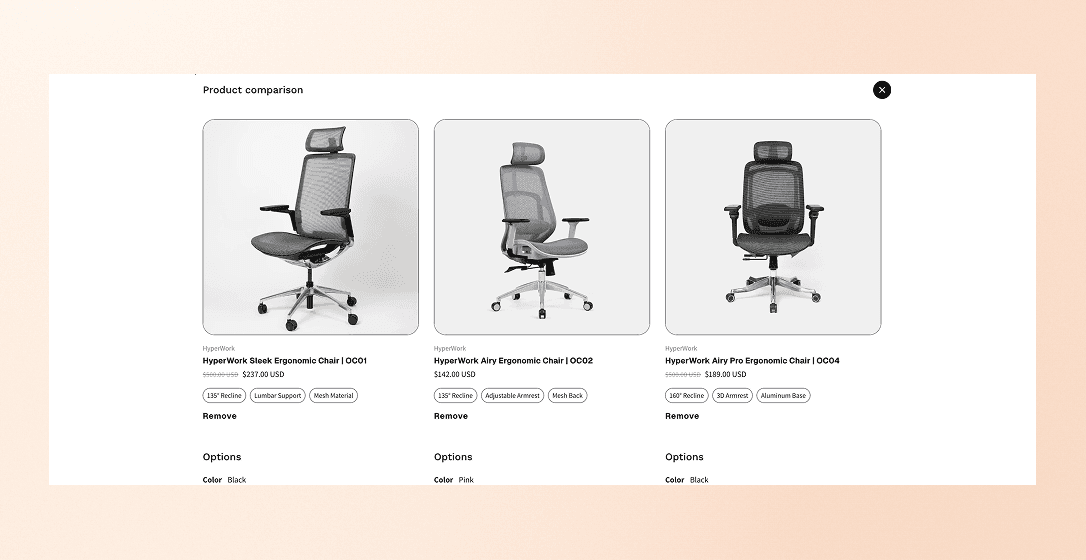
Once that information exists, the next problem is structure. A privacy summary buried in a paragraph doesn't let a shopper filter for "works with Apple Home" or compare two thermostats side by side on subscription cost. That data needs to live in structured product attributes, not just body copy.
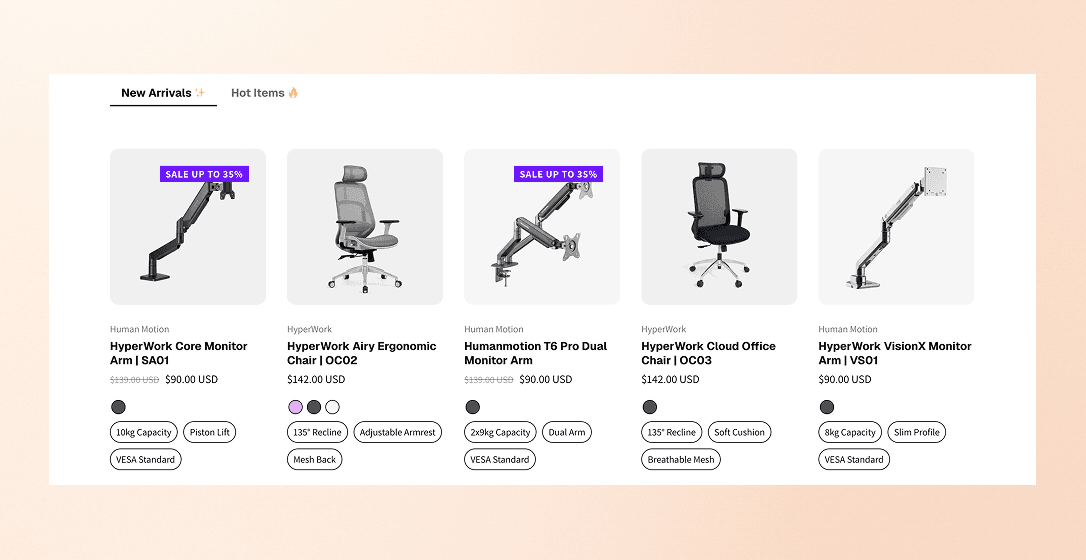
If you're running a multi-category electronics store, this is exactly the kind of spec data attribute filters and a comparison table are built to surface: ecosystem, hub requirement, subscription, security-update period, laid out side by side instead of buried in separate descriptions. Electro's filter and comparison layout was built for shoppers who compare specs before they commit, which is the same behavior a smart home buyer runs through. See Electro's spec-driven layout.
Takeaways
- Cost is the single biggest reason smart home shoppers walk away, and hidden subscriptions are a big piece of it. State full cost of ownership on the page.
- Privacy and security together account for 40% of non-buyer objections. A plain-language data summary answers more of that than any badge could.
- Regulation, from the UK's PSTI Act to the EU's Cyber Resilience Act, is turning "trust us" into "disclose it." Get ahead of it voluntarily.
- The Cyber Trust Mark is still pre-launch in the US, so skip the badge until it's real.
- Setup friction still drives returns. A realistic setup time and a short video beat "quick and easy" every time.
FAQ
What do smart home buyers worry about most?
Among people who looked and didn't buy, cost is the top reason, cited by 36%, followed by privacy at 21% and security at 19%. Setup difficulty and compatibility worries trail at 9% and 4% (451 Research, Sept 2026).
Should I list Matter compatibility on my product page?
Yes, if it's true. Matter 1.6, released by the Connectivity Standards Alliance in June 2026, is the current cross-platform standard, and it includes a real, checkable security certification tier (CSA, via Privacy Guides, June 2026). There's no public adoption-count data to cite alongside it, so don't invent a percentage of the market that's "on Matter."
Is the US Cyber Trust Mark available yet?
No. As of August 2026, the FCC is still accrediting the administrators who will run the program. No product can currently carry the mark, and a page that implies otherwise is making a claim that isn't true yet (Cybersecurity Dive, 2026).
What should a smart home product page include?
At minimum: the ecosystems it works with, whether a subscription is required and its price, a plain-language data summary, a stated security-update period, a vulnerability-disclosure contact, and a realistic setup time with a video. Each item maps to a documented buyer hesitation, not a guess.
See it laid out on Electro
If you're building or auditing a smart home or IoT product page inside a larger electronics catalog, Electro's spec layout and comparison tables are built to hold this kind of structured data. See Electro, or read the broader roundup of the best Shopify themes for electronics stores.
More from the blog

Ready to convert more?
Stop leaving revenue on the table.
Your theme is the highest-leverage conversion tool you have.